| |
|
 |
| solar install |
by bkusler on Flickr |
|
- Every hour the sun beams onto Earth more than enough energy to satisfy global energy needs for an entire year.
- Solar energy is the technology used to harness the sun's energy and make it usable.
- Today, the technology produces less than 1/10th of one percent of global energy demand.
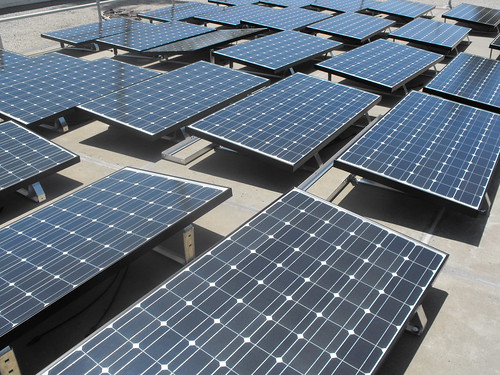
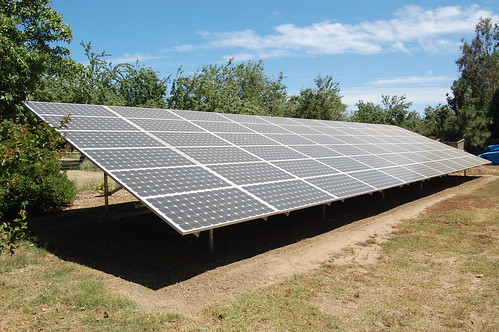
- Many people are familiar with so-called photo-voltaic cells, or solar panels, found on things like spacecraft, rooftops, and handheld calculators.
- The cells are made of semiconductor materials like those found in computer chips.
- When sunlight hits the cells, it knocks electrons loose from their atoms.
- As the electrons flow through the cell, they generate electricity.
|
 |
| Wayne National Forest Solar Panel Construction |
by Wayne National Forest on Flickr |
|
- On a much larger scale, solar thermal power plants employ various techniques to concentrate the sun's energy as a heat source.
- The heat is then used to boil water to drive a steam turbine that generates electricity in much the same fashion as coal and nuclear power plants, supplying electricity for thousands of people.
- In one technique, long troughs of U-shaped mirrors focus sunlight on a pipe of oil that runs through the middle.
- The hot oil then boils water for electricity generation.
- Another technique uses movable mirrors to focus the sun's rays on a collector tower, where a receiver sits.
- Molten salt flowing through the receiver is heated to run a generator.
|
 |
| Port of San Diego's Green Port Program |
by Port of San Diego on Flickr |
|
- Other solar technologies are passive. For example, big windows placed on the sunny side of a building allow sunlight to heat-absorbent materials on the floor and walls. These surfaces then release the heat at night to keep the building warm. Similarly, absorbent plates on a roof can heat liquid in tubes that supply a house with hot water.
- Solar energy is lauded as an inexhaustible fuel source that is pollution and often noise free. The technology is also versatile. For example, solar cells generate energy for far-out places like satellites in Earth orbit and cabins deep in the Rocky Mountains as easily as they can power downtown buildings and futuristic cars.
|
 |
| Wayne National Forest Solar Panel Construction |
by Wayne National Forest on Flickr |
|
- Solar energy doesn't work at night without a storage device such as a battery, and cloudy weather can make the technology unreliable during the day.
- Solar technologies are also very expensive and require a lot of land area to collect the sun's energy at rates useful to lots of people.
- Despite the drawbacks, solar energy use has surged at about 20 percent a year over the past 15 years, thanks to rapidly falling prices and gains in efficiency.
- Japan, Germany, and the United States are major markets for solar cells.
- With tax incentives, solar electricity can often pay for itself in five to ten years.
|
 |
| Solar Panels All Done! |
by Clownfish on Flickr |
|
- Solar energy is all around us everyday. Without it, we would not exist.
- When we wake up in the morning or sleep at night, it provides us with light and warmth.
- When we talk about solar energy, most people think about solar panels, however, wind energy, non-renewable fossil fuels (petroleum, gas and coal) and hydro-power would not exist without the sun’s involvement and are in fact another variation of solar energy.
|
 |
| Solar Panels |
by dirvish on Flickr |
|
- The sun has been around for about 4.5 billion years and is expected to be around for another 4-5 billion years.
- The output of solar energy that the sun delivers to earth is absolutely enormous.
- Theoretically, if we could harness the energy from one hour of sunlight from around the world, it could provide the energy needs for the entire world’s population for a year!
- Further, it should also be noted that only about 50% of the sun’s energy actually reaches the surface of the earth.
- In addition to being abundant, solar energy is both clean and renewable and available almost anywhere on our planet.
|
 |
| Wayne National Forest Solar Panel Construction |
by Wayne National Forest on Flickr |
|
- Power from the sun makes life on earth possible–and always has. Isn’t it interesting that we refer to solar power as “alternative energy”?
- Technological advances over the past couple of decades have made solar power into an efficient and affordable source of electricity, in addition to everything else the sun does for us.
- It makes sense to call it an alternative in comparison to burning fossil fuels or using nuclear plants.
- The more electricity we can get from the sun, the less we will have to suffer the environmental and geopolitical consequences of these other fuels.
|
 |
| Urban Oasis - Birmingham |
by Lee Jordan on Flickr |
|
- It is an interesting point that solar technology is advancing at a rapid speed each day.
- The cost that one may incur when purchasing solar panels has decreased dramatically in the recent years.
- For this reason, many home owners have established solar systems within their homes on their dwellings without straining financially.
- Moreover solar energy is becoming an ubiquitous technology in the sense that it is more accessible and cost effective now than it was a decade ago.
|
 |
| Arizona State University goes solar! |
by kevindooley on Flickr |
|
To get most out of solar panels, install the panels on a relatively large area. You can easily add more solar panels to meet increasing energy needs.
|


 NeoK12.com - Educational Videos, Lessons, Quizzes & Presentations