| | |
 | | Red and Black Beauty!! | by spisharam on Flickr |
| - Most reptiles are carnivorous and have rather simple and comparatively short digestive tracts, meat being fairly simple to break down and digest.
- Digestion is slower than in mammals, reflecting their lower resting metabolism and their inability to divide and masticate their food.
|
 | | Golden Eye | by OakleyOriginals on Flickr |
| - A reptile's metabolism has very low energy requirements, allowing large reptiles like crocodiles and the large constrictors to live from a single large meal for months, digesting it slowly.
|
 | | Turtle on log | by JamieS93 on Flickr |
| - Today the turtles are the only predominantly herbivorous reptile group, but several lines of agamas and iguanas have evolved to live wholly or partly on plants.
|
 | | Indian Cobra (Naja naja) | by Gopal Venkatesan on Flickr |
| - The Indian cobra feeds on rodents, lizards and frogs.
- It
bites quickly, and then waits while its venom damages the nervous system of the
prey, paralyzing and often killing it.
|
 | | Crokodile 07 | by DeusXFlorida on Flickr |
| - Crocodiles are carnivorous,
and live on fish, rodents and small animals. Large crocodiles kill larger
prey such as cows, buffalos, or horses.
- When the food is scarce, a large
croc could even eat smaller crocodiles.
- They will also eat
dead animals if they find them.
- Their smell is quite good, and they can
detect dead/decayed animals from several kms.
- Since they tear off large pieces
to swallow whole, it takes them some time to digest this food, up to 3 to
7 days. For this they need to bank in the sun, to get their temperatures
right. If they don’t control their body temperature sufficiently for this,
the meat in its guts might start to rot, and this could kill the crocodile.
|
 | | Aligator0111 | by DeusXFlorida on Flickr |
| - On dissection, alligators’ stomachs are found to contain stones, fishing lures, a number of items and cans.
- Mostly their feeding time is at nights.
- Alligators don’t chew or cut their meal. They swallow their prey as a whole.
- If they happen to catch larger animals, they can’t cut them just by the use of their teeth; rather they will have to shake and swing their head or spin their bodies to tear out a piece that they can swallow.
- Sometimes, they even hold their food in their mouths for so long to let it deteriorate and become suitable to swallow.
|
 | | Green Iguana | by wwarby on Flickr |
| - Green
iguanas are entirely herbivorous and they require a diet that is composed
of calcium rich greens, vegetables and fruits.
|
 | | Bearded dragon | by tanakawho on Flickr |
| - Bearded dragons
like to eat plants and vegetation or insects of any kind. They also will
sometimes eat a small rodent or a lizard, with their large stomachs.
|
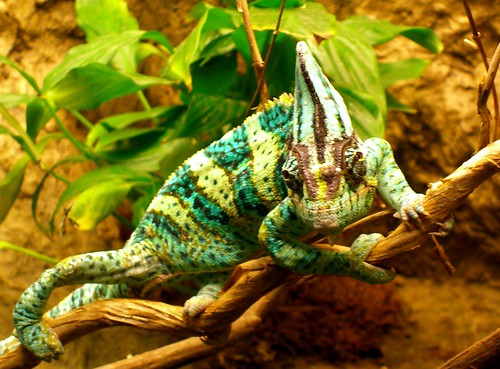 | | Veiled Chameleon | by walknboston on Flickr |
| - Herbivorous reptiles face the same problems of mastication as herbivorous mammals but, lacking the complex teeth of mammals, many species swallow rocks and pebbles (so called gastroliths) to aid in digestion:
- The rocks are washed around in the stomach, helping to grind up plant matter.
|


 NeoK12.com - Educational Videos, Lessons, Quizzes & Presentations