| Share Presentation: https://NeoK12.com/pres/ZICEAGE3 | |


Talia's Ice Age Information
| An ice age, or more precisely, a glacial age, is a period of long-term reduction in the temperature of the Earth's surface and atmosphere, resulting in the presence or expansion of continental ice sheets, polarice sheets and alpine glaciers.
There are three main types of evidence for ice ages: geological, chemical, and paleontological.
| ||||
| There have been at least five major ice ages in the Earth's past (the Huronian, Cryogenian, Andean-Saharan, Karoo Ice Age and the Quaternary glaciation). Outside these ages, the Earth seems to have been ice-free even in high latitudes. The earth is currently in an interglacial, and the last glacial period ended about 10,000 years ago. All that remains of the continental ice sheets are the Greenland and Antarctic ice sheets and smaller glaciers such as on Baffin Island.
| ||||
| Although the last glacial period ended more than 8,000 years ago, its effects can still be felt today. For example, the moving ice carved out the landscape in Canada (See Canadian Arctic Archipelago)
The geological record appears to show that ice ages start when the continents are in positions which block or reduce the flow of warm water from the equator to the poles and thus allow ice sheets to form. The ice sheets increase the Earth's reflectivity and thus reduce the absorption of solar radiation. With less radiation absorbed the atmosphere cools; the cooling allows the ice sheets to grow, which further increases reflectivity in a positive feedback loop. The ice age continues until the reduction in weathering causes an increase in the greenhouse effect. | ||||
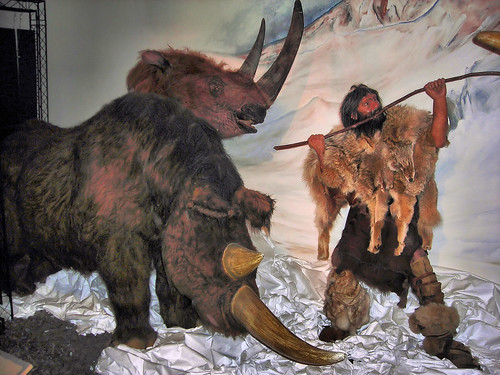
| Woolly Mammoth! Survived in Ice Age Tusks used to move snow | ||||



Share this Presentation: https://NeoK12.com/pres/ZICEAGE3 NeoK12.com - Educational Videos, Lessons, Quizzes & Presentations
NeoK12.com - Educational Videos, Lessons, Quizzes & PresentationsAll images are linked from Flickr Creative Commons under CC BY, CC BY-SA, CC0. Click attribution link under image for full details.