| | |
 | | Cosmic Heavyweights in Free-For-All: One of the most complex galaxy clusters, located about 5.4 billion light years from Earth. | by Smithsonian Institution on Flickr |
| Galaxy: A massive system containing planets and clusters of stars. The word "galaxy" comes from the Greek word "galaxias".
Picture on the Left: A complex galaxy, about 5.4 billion light years from planet Earth.
|
 | | iPhone Background - Spiral Galaxy | by Patrick Hoesly on Flickr |
| An example of a galaxy is the milky way. - It is estimated to be 13.2 billion years old.
- The milky way is said to be 100 000-120 000 light years in diameter.
- The milky way is a spiral galaxy, and is estimated to contain over 50 billion planets.
- The galaxies are seen through telescopes.
- The Milky Way has a Super massive black hole at the Galactic Center, called Sagittarius A.
- There are a couple of theories about how the milky way was formed. One is that the big bang created the Milky Way, and the other is that the Milky Way was formed from a single, large, cloud of gas.
|
 | | iPhone Background - Spiral Galaxy | by Patrick Hoesly on Flickr |
| - There is an estimated number of 100-200 billion galaxies in the universe
- Youngest galaxy is 1 Zicwy 18, which is only 500 million years old.
- The canis major dwarf galaxy is the galaxy closest to ours, located "only" 42,000 light years away.
|
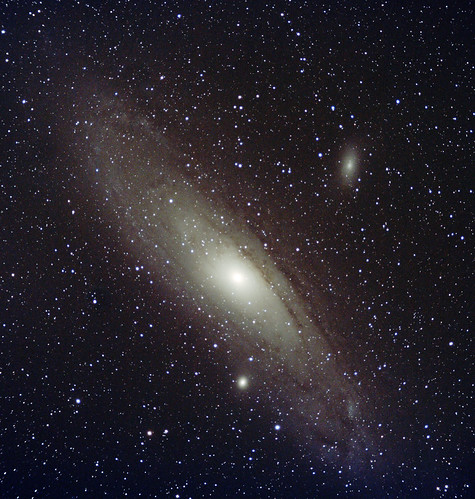 | | The Andromeda Galaxy - M31, M32, and M110 | by madmiked on Flickr |
| There are 3 major types of galaxies: - Spiral, which is spiral,
- Elliptical, which is shaped like an ellipse,
- Irregular, that doesn't really have a shape.
|
 | | Westerlund 1 (A dense cluster of young stars about 16,000 light years from Earth.) | by Smithsonian Institution on Flickr |
| Why Do galaxies spin ?
- One thought is that the black holes are in the center of the galaxy, which causes the galaxy to spin.
- Another theory has to do with gravity causing it to move toward each other.
|


 NeoK12.com - Educational Videos, Lessons, Quizzes & Presentations