| Share Presentation: https://NeoK12.com/pres/ZGALAXY1 | |


The Wonders of Galaxies
|
A galaxy is a massive, gravitationally bound system that consists of stars and stellar remnants, an interstellar medium of gas dust, and an important but poorly understood component tentatively dubbed dark matter.
| ||||
|
The name in greek means milky, a reference to Milky Way.
| ||||
|
The galaxy typical range from dwarf has about ten-million to a hundred-trillion stars in it.
| ||||
|
Galaxies may contain : -star systems -star clusters -interstellar clouds The sun is one of the stars in the galaxy. | ||||
|
Galaxies have been organized by their apparent shape. A common form is the "eliptical galaxy". Small galaxies that lack a coherent structure could also be referred to as irregular galaxies. | ||||
|
It is known that there is at least 170 billion
galaxies in the observable universe. | ||||
|
The word galaxy derives from the Greek term for our own galaxy, galaxias (γαλαξίας), or kyklos galaktikos, meaning "milky circle" for its appearance in the sky.
In Greek mythology, Zeus places his son born by a mortal woman, the infant Heracles, on Hera's breast while she is asleep so that the baby will drink her divine milk and will thus become immortal. | ||||
|
The Greek philosopher Democritus proposed that the bright band on the night sky known as the Milky Way might consist of distant stars.
Aristotle, however, believed the Milky Way to be caused by "the ignition of the fiery exhalation of some stars which were large, numerous and close together" and that the "ignition takes place in the upper part of the atmosphere, in the region of the world which is continuous with the heavenly motions. | ||||
|
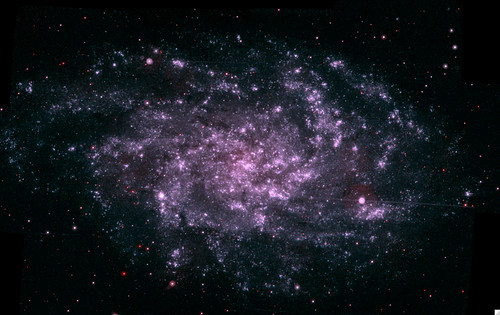
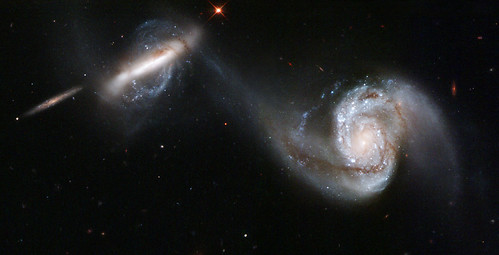
Galaxies come in three main types: -ellipticals -spirals -irregulars | ||||
|
A majority of spiral galaxies have a linear, bar-shaped band of stars that extends outward to either side of the core, then merges into the spiral arm structure.
| ||||
|
Despite the prominence of large elliptical and spiral galaxies, most galaxies in the universe appear to be dwarf galaxies.
| ||||
|
The average separation between galaxies within a cluster is a little over an order of magnitude larger than their diameter.
| ||||
|
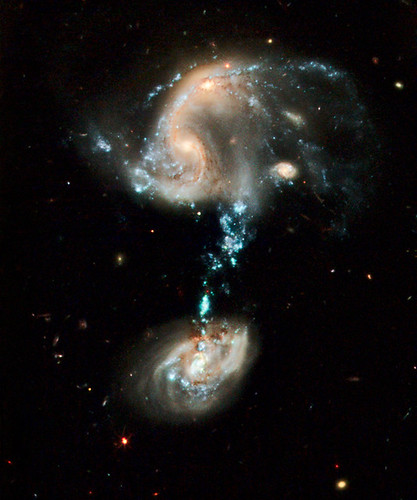
Stars are created within galaxies from a reserve of cold gas that forms into giant molecular clouds. Some galaxies have been observed to form stars at an exceptional rate, known as a starburst.
| ||||
|
A portion of the galaxies we can observe are classified as active.
| ||||





Share this Presentation: https://NeoK12.com/pres/ZGALAXY1 NeoK12.com - Educational Videos, Lessons, Quizzes & Presentations
NeoK12.com - Educational Videos, Lessons, Quizzes & PresentationsAll images are linked from Flickr Creative Commons under CC BY, CC BY-SA, CC0. Click attribution link under image for full details.