| Share Presentation: https://NeoK12.com/pres/ZENESRC1 | |


|
Wind is the movement of air from an area of high pressure to an area of low pressure. In fact, wind exists because the sun unevenly heats the surface of the Earth. As hot air rises, cooler air moves in to fill the void. As long as the sun shines, the wind will blow. And as long as the wind blows, people will harness it to power their lives
| ||||
|
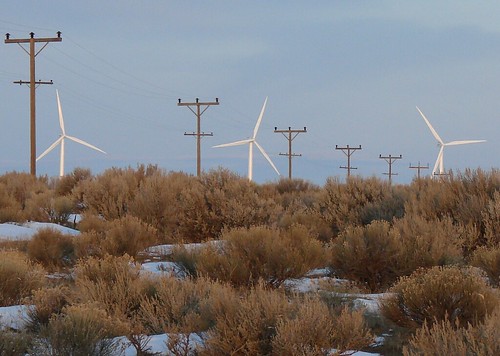
Most wind energy comes from turbines that can be as tall as a 20-story building and have three 200-foot-long (60-meter-long) blades. These contraptions look like giant airplane propellers on a stick. The wind spins the blades, which turn a shaft connected to a generator that produces electricity. Other turbines work the same way, but the turbine is on a vertical axis and the blades look like a giant egg beater.
| ||||
|
The biggest wind turbines generate enough electricity to supply about 600 U.S. homes. Wind farms have tens and sometimes hundreds of these turbines lined up together in particularly windy spots, like along a ridge. Smaller turbines erected in a backyard can produce enough electricity for a single home or small business.Wind is a clean source of renewable energy that produces no air or water pollution. And since the wind is free, operational costs are nearly zero once a turbine is erected. Mass production and technology advances are making turbines cheaper, and many governments offer tax incentives to spur wind-energy development. | ||||
|
Interesting Facts | ||||
|
Some people think wind turbines are ugly and complain about the noise the machines make. The slowly rotating blades can also kill birds and bats, but not nearly as many as cars, power lines, and high-rise buildings do. The wind is also variable: If it's not blowing, there's no electricity generated.Industry experts predict that if this pace of growth continues, by 2050 the answer to one third of the world's electricity needs will be found blowing in the wind
| ||||
|
Since ancient times man has harnessed the power of the wind, the earliest known wind mills were vertical axis type, developed by the Persians in 500-900 A.D. One of the most scenic and historic applications of wind power can still be found on the Island of Crete; electric motors of pre-industrial Europe | ||||
|
The first windmills in Europe were developed in 1270 A.D. and were of the horizontal axis type. By 1390 A.D, the Dutch set out to refine the tower mill design and after 500 years of incremental developments the wind sails had all the major features recognized by modern designers. Wind mills were the electric motors of pre-industrial Europe.
| ||||
|
Water pumping systems were perfected in 1854, beginning with the Halladay, and continuing with the Dempster Design wind mills. By the end of the 19th Century, the first use of a windmill to generate electricity was a system built in Cleveland, Ohio, in 1888 by Charles F. Brush
| ||||
|
Wind energy is renewable. Wind does not need to be produced, like ethanol does, so there will always be a constant supply of it. Wind energy is very expensive to set up, so it requires significant amounts of capital to establish wind farms. After the initial investment and startup costs, however, it is one of the cheapest forms of electricity generation to maintain | ||||
|
Interesting Facts In 2005, wind accounted for 1% of the total electricity production in the world. The United States was third in utilization of wind energy, with Germany being the leading producer. According to the Department of Energy, offshore wind farms could provide enough energy to power the entire nation. Clearly what we see here is that we have barely touched the amazing capabilities of wind power, and we can expect to see wind power become a massive source of renewable energy in the U.S., and around the globe. | ||||
|
Important Facts In Denmark, wind power now produces approximately 20% of the country's electricity consumption, and in recent surveys, 90% of the citizens wanted more wind turbines installed. What we are starting to see is through these wind energy facts is that we have not taken wind energy seriously enough. There is an incredible amount of energy that can be generated through the power of wind. Until we realize just how awesome this energy source is, we will be left to worry about rising fuel costs and the problems that fossil fuels create for humans, animals, and the environment. Let's hope that wind energy is taken more seriously on a global scale | ||||
|
The terms "wind energy" or "wind power" describe the process by which the wind is used to generate mechanical power or electricity. Wind turbines convert the kinetic energy in the wind into mechanical power. This mechanical power can be used for specific tasks (such as grinding grain or pumping water) or a generator can convert this mechanical power into electricity to power homes, businesses, schools, and the like. | ||||
|
Winds are caused by the uneven heating of the atmosphere by the sun, the irregularities of the earth's surface, and rotation of the earth. Wind flow patterns are modified by the earth's terrain, bodies of water, and vegetative cover. This wind flow, or motion energy, when "harvested" by modern wind turbines, can be used to generate electricity
| ||||
|
Wind turbines, like aircraft propeller blades, turn in the moving air and power an electric generator that supplies an electric current. Simply stated, a wind turbine is the opposite of a fan. Instead of using electricity to make wind, like a fan, wind turbines use wind to make electricity. The wind turns the blades, which spin a shaft, which connects to a generator and makes electric. Modern wind turbines fall into two basic groups; the horizontal-axis variety, like the traditional farm windmills used for pumping water, and the vertical-axis design, like the eggbeater-style Darrieus model, named after its French inventor. Most large modern wind turbines are horizontal-axis turbines | ||||




 NeoK12.com - Educational Videos, Lessons, Quizzes & Presentations