| | |
 | | Sea Lion: Up Close and Personal | by NOAA's National Ocean Service on Flickr |
| Sea Lions are endangered animals because of killer whales.. - They are marine mammals. Males can weigh up to 800 pounds and be 9 ft long while females can weigh up to 400 pounds and be 6 ft long.
- They can hold their breath for up to 20 mins
- They eat a variety of fish.
- They have external ear flaps, long fore-flippers and short thick hair.
|
 | | Longsnout Seahorse (Hippocampus reidi) | by cliff1066� on Flickr |
| Seahorses are tiny fishes that are named for the shape of their head, which looks like the head of a tiny horse. - Male Seahorse has a pouch called brood pouch on its stomach to carry babies. A female seahorse lays dozens, sometimes hundreds, of eggs in the brood pouch for the male to carry until they hatch.
- Adult seahorses range from less than 2 inches to 1 ft. long.
- Seahorses eat tiny organisms, sucking the animals in through their tube-like snout.
- Seahorses can move their eyes independently of each other, helpful when keeping an eye out for predators.
|
 | | Channel Catfish (Ictalurus punctatus) | by cliff1066� on Flickr |
| Catfish are most easily identified by their flattened broad heads and the long whisker-like barbels that protrude from the mouth of the catfish.- Cat fish can live in salt water and fresh water..
- The long barbels of the catfish are often most commonly used for smelling and therefore sensing what is about to eat (and to hide from) in the surrounding waters.
- Despite the name however, not all catfish species have prominent whisker-like barbels.
|
 | | Leopard Shark (Triakis semifasciata) | by cliff1066� on Flickr |
| This is a 3 year old Leopard Shark. - The Leopard Shark is named after its characteristic display of dark brown markings found on its body resembling those of a leopard.
- Despite being called sharks, they are normally not regarded as much of a threat to humans.
- Their counterparts, great white sharks, do prey on leopard sharks alongside other marine animals such as killer whales.
|
 | | Atlantic Spadefish (Chaetodipterus faber) | by cliff1066� on Flickr |
| This is Atlantic Spadefish. - It is silvery gray in color with vertical black bars. It is named for its characteristic spade shaped body, which is compressed with a short snout.
- It reaches a maximum length of about 3 ft. and maximum reported weight of about 19 pounds.
- Feeds on crustaceans such as crab, lobster, shrimp etc, small invertebrates and may nibble on tentacles of jellyfish.
|
 | | Lionfish (Pterois volitans) | by cliff1066� on Flickr |
| Lionfish is among the most poisonous fish in the world. - They use their sharp needle-like blades to inject venom into a potential attacker. They aren’t known to use it when they go after prey.
- They use their awesome colors to blend into the reefs i.e camouflage, to find potential prey or hide from predators.
- Eat mostly fish, shrimp, and crabs
- They tend to hide during the night in small caves or ledges and they hunt during the day.
- Average lifespan is around 15 years. They can grow to an average length of 12 inches.
|
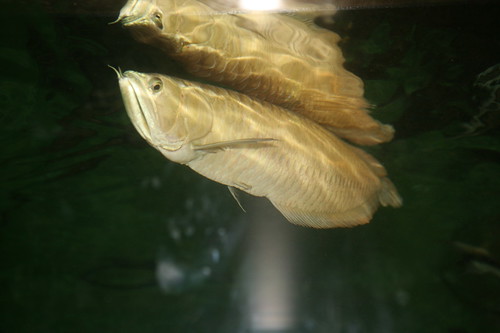 | | Silver Arowana (Osteoglossum bicirrhosum) | by cliff1066� on Flickr |
| Silver Arowana is a tropical freshwater fish. - Can grow to a length of 47 inches
- Adult has a silvery color while the juvenile has blue glints and yellow orange bar.
- Preys largely on other fish near the surface
- Can jump almost 5 ft out of the water to feed on large insects
- Eggs are externally fertilized and the male then carries them in his mouth until they hatch.
|
 | | Swell Shark (Cephaloscyllium ventriosum) | by cliff1066� on Flickr |
| Swell Sharks swim on the bottom of the ocean floor.. - If threatened, swell shark bends its body into a sharp U-shape, grasps its tail fin in its mouth and swallows large quantity of sea water, which makes it swell to twice its normal size. This behavior makes it difficult for a predator to bite or evict a swell shark from its rocky crevice.
- Brown blotches and white spots decorate the swell shark's yellow brown body.
- It feeds during night on other fishes. It captures by resting open mouthed and letting prey wander in or be carried in by currents.
|
 | | Red Bellied Piranha (Pygocentrus nattereri) | by cliff1066� on Flickr |
| Red Bellied Piranha are the most ferocious freshwater Fish in the world. - Piranha has extremely sharp teeth and a voracious appetite for meat and fish.
- Piranhas are omnivores eating fish, meat, birds, insects, plants and seeds
- Piranha feeds on other Piranhas in a frenzied state
- Piranha stats
- Weight: 3.5 kg
- Length: Upto 18 inches
- Habitat: Rivers in South America
- Lifespan: 25 years
|
 | | Pumpkinseed Sunfish (Lepomis gibbosus) | by cliff1066� on Flickr |
| Pumpkinseed Sunfish prefer shallow, warm water with abundant vegetation in which to hide - Have a disc-shaped, slab-sided body with a small mouth and sharp spines
- It is their body shape, resembling the seed of a pumpkin that inspired their name.
- Length: Average 6-8 inches
- Weight: less than 1 pound
- Lifespan: In the Wild 8-9 years
|
 | | Flag Cichlid (Mesonauta festivus) | by cliff1066� on Flickr |
| This is a Flag Cichlid he is skimming the bottom of the ocean floor for food.. |
 | | Manta Ray Cleaning Station | by NOAA's National Ocean Service on Flickr |
| Manta Rays are large graceful animals that live in the ocean. They belong to a group of fish that have cartilage instead of bone. - The name Manta means blanket and the fact that this creature looks like a blanket as it moves in the water is part of the namesake.
- Live in warm and temperate waters
- Eat plankton
- Grow upto 25 feet in length and weigh as much as 3000 pounds
- Has the largest brain to body ratio among all the sharks and rays on Earth
- Average life span is 20 years
|
 | | Sea Turtle | by NOAA's National Ocean Service on Flickr |
| Sea Turtles are reptiles that live primarily in the ocean. - They come in different sizes - largest can be up to 6 ft long and weigh well over 1,000 pounds.
- Have flippers that enable them to swim well and also help propel them on land.
- Eat all kinds of food including sea grass, seaweed, crabs, jellyfish and shrimp.
- Lifespan is 70-80 years
|
 | | A corn-cricket in front of our tent, at night, in Ziwani | by frederic.salein on Flickr |
| This little Corn Cricket runs along the beaches at night.. |
 | | Nautilus | by cliff1066� on Flickr |
| This Nautilus is along the bottom of the ocean.. |
 | | Altum Angelfish (Pterophyllum altum) | by cliff1066� on Flickr |
| Altum Angelfish is hiding in the plant life so that the predator can't find it.. |
 | | Discus (Symphysodon discus) | by cliff1066� on Flickr |
| Discus also hides in the coral and reef from its predators.. |
 | | Spotfin Hogfish (Bodianus pulchellus) | by cliff1066� on Flickr |
| Spotfin Hogfish hides in the reefs and corals from its predators.. |
 | | Northern Puffer (Sphoeroides maculatus) | by cliff1066� on Flickr |
| This Northern Puffer will puff up into a ball in self defense |
 | | Pacific Blue Tang (Paracanthurus hepatus) | by cliff1066� on Flickr |
| This is the Pacific Blue Tang - Lives in coastal waters, coral reefs and inshore rocky or grassy areas.
- In the coral reefs, they live in holes or creases where they are safe from predators at night
|
 | | Longsnout Seahorse (Hippocampus reidi) | by cliff1066� on Flickr |
| This Longsnout Seahorse is hiding in the reef from its predators.. |
 | | Bicolor damselfish (Stegastes partitus) | by cliff1066� on Flickr |
| This Bicolor damselfish is eating the micros off the coral.. |


 NeoK12.com - Educational Videos, Lessons, Quizzes & Presentations